
Lancaster County City Directory Holdings
Lincoln supplies the core city directory evidence for Lancaster County. The strongest local access point is Bennett Martin Public Library's Local History Center, where requested material is used inside the library. Its holdings distinguish a microfilm run from 1873 through 1972, a most-used run from 1876 through 2023, and most years from 1873 forward in some format. That is broad coverage, not a promise that every annual volume survives. The library specifically notes gaps, especially in the 1940s.
| Local collection | Documented span | Custodian | How to consult it |
|---|---|---|---|
| Lincoln city directories on microfilm | 1873-1972 | Bennett Martin Local History Center | Requested onsite use; gaps remain |
| Most-used Lincoln city directories | 1876-2023 | Bennett Martin Local History Center | Onsite reference collection |
| Hoye's Directory of Lincoln City | 1891 | UNL Digital Commons | Public digital scan |
| Early Lincoln directory file | 1873-1941, practically complete | History Nebraska | Research-room and catalogue route |
| Lincoln telephone directories | 1904-2022 or 1928-present, by guide | Bennett Martin Local History Center | Onsite, with year-by-year checking |
The two telephone-directory date ranges come from different library guides, so the exact volume should be checked before relying on it. The city directory collection is a historical shelf, not a modern list of every person. For a rural household, the 1921 Atlas of Lancaster County alphabetical index of residents and family members can provide a separate lead when a Lincoln volume does not.
Lincoln's City Directory Shelf
The Bennett Martin Local History Center is on the second floor of 136 South 14th Street in Lincoln. Call 402-441-8500 before a visit, then request the needed directory or microfilm for use within the building. The same local-history collection connects directory work with local newspapers, digitized Lincoln Public Schools yearbooks, cemetery books, the Alba-Brown Mortuary Records, and Sanborn maps. That proximity helps when an address or surname needs confirming evidence.
The Local History Center collection page identifies the historical sources available at the library.
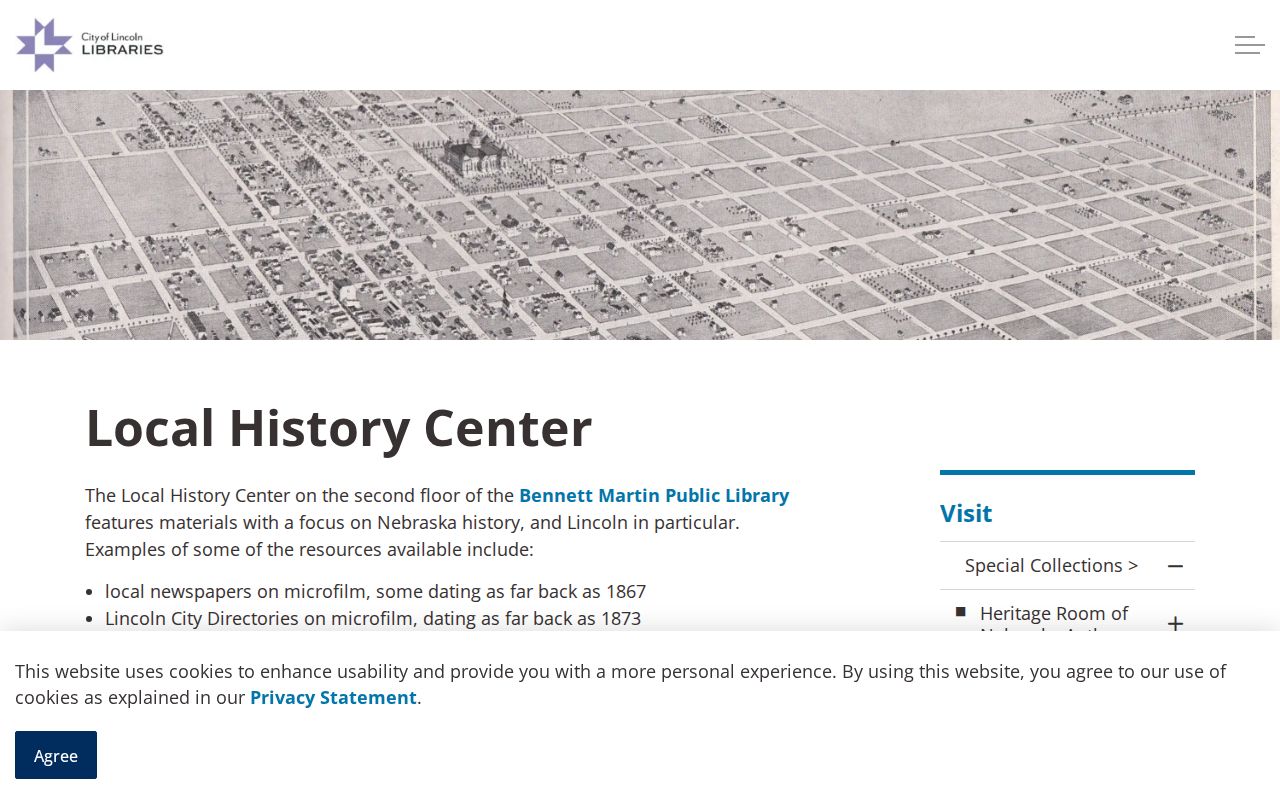
Use the library image as a reminder that this material is request-only onsite, rather than assuming a shelf or a web search will expose every volume.
History Nebraska offers a second Lincoln research stop at 1500 R Street. Its research holdings include county and town histories, newspapers, original Sanborn maps, family histories, court and naturalization material by county, and military collections. A directory hit becomes more useful when those sources help distinguish two people with similar names.
The Research Room also reports more than 3,000 family histories and biographical files, more than 3,500 newspaper titles on roughly 40,000 reels, maps from the pre-territorial period through the 1980s, and military service cards from the Civil War through World War I. Those are paths for testing a precise historical claim. They are not substitutes for the city directory's date, page, and printed address.
1891 Hoye City Directory Scan
For a clearly identified early volume, UNL Digital Commons preserves Hoye's Directory of Lincoln City, issued by W. C. Hoye in 1891. The scan is approximately 540 pages and was made in color at high resolution so the fragile original need not be handled repeatedly. At least one front-matter leaf is missing, which matters if the abbreviation key or publishing detail was printed there.
UNL's Hoye directory record supplies the digitized source behind this image.
The digitized volume is an early primary source, while later publisher names and precise publisher-to-year runs should come from the title page of the volume being used. The available holding lists do not support assuming a single later publisher.
History Nebraska's 1941 catalogue calls its Lincoln directory file practically complete from 1873 through 1941, helped by John S. Bishop's gift of fifty volumes beginning in 1887. The catalogue is valuable beyond the dates: it identifies sections on directory arrangement, the city's growth and adjacent territory, street and avenue changes, and directory advertising. Use that context to form a search, then verify each person in the underlying volume.
Reading Lancaster City Directory Entries
Read an entry as a dated snapshot, and record what is actually printed. The Hoye scan's text view was not sufficient to transcribe a named residential entry during research, so abbreviations should not be guessed. Name spelling, initials, the street address, an occupation or business reference, household notation, and a page or section can be useful only when they are visible in the specific volume. An absence is not proof that a person was away. Canvass timing, a spelling variation, nonresponse, or a different local place can all explain it.
| Printed name | Record surname, initials, spelling, and any middle name exactly as shown. |
|---|---|
| Street address | Capture the number, street wording, and punctuation, then compare it with the year's street guide. |
| Occupation or business text | Use it as a differentiator only if the entry itself prints it. |
| Household notation | Note a spouse, widow or other household reference only when the volume supplies it. |
| Edition context | Save the title page, year, page, and section before interpreting any abbreviations. |
- Criss-cross section
- An address or street-ordered section, if the particular directory includes one, that can lead from a place to listed names.
- Householder index
- An alphabetical finding aid for household heads or listed residents, not evidence that every person at the address appears.
- Abbreviation key
- The volume's own explanation of shortened terms. Photograph or note it before decoding an entry; the Hoye front matter is incomplete.
Bridging Lancaster Directory Gaps
When the target year falls in one of the known 1940s gaps, use a nearby city directory as a bracket rather than inventing a continuous run. Telephone books can narrow the interval. The Nebraska State Journal is available from 1867 to 1950, the Lincoln Star from 1902 to 1995, and the Lincoln Journal Star has later coverage. Newspaper notices can suggest a move, death, marriage, estate event, or civic activity, but they do not prove continuous residence.
History Nebraska's 1941 directory catalogue also describes a street-and-avenue name-change key. That is important for a historical Lincoln address. Compare an older street name with plats, Sanborn maps, and current county GIS before deciding a household changed homes. Note: a directory cover year and a federal census date are different snapshots of a household.
Lincoln's Annexed Directory Names
Place names are part of the search. Havelock, University Place, and College View became part of Lincoln through annexations between 1926 and 1930. A person can therefore appear under one of those community labels in an older directory and under Lincoln later without moving. The 1873 directory guide, plats, Sanborn maps, and the City of Lincoln annexation material are the safer bridge than a modern map alone.
Early central Lincoln usually has the deepest directory and newspaper layer. Newer edges may first appear in subdivision plats, permits, assessor records, and later directories. Rural residents may instead appear in the 1921 atlas index or census material.
Tracing Lancaster City Directory Households
A household trail needs both a name path and an address path. Start at the newest available city directory that fits the question, then move backward one volume at a time. Search a spouse, a middle initial, a familiar street, or a business reference when a surname disappears. Check the alphabetical resident section first and the street or reverse section only if the actual volume contains one. The public federal census currently reaches 1950 under the 72-year rule, while the next decennial release is expected in 2032.
- Copy the name, address, edition year, page, and every visible qualifier from one directory entry.
- Search nearby years backward and forward, recording each address change and spelling variation.
- Use a street or reverse section when that volume provides one, then compare nearby listed names cautiously.
- Pair a directory period with the closest public census schedule to test household composition on its enumeration date.
- Use a deed, permit, newspaper notice, obituary, probate file, or cemetery record to test whether a disappearance reflects a move or death.
A directory resident may be an owner, a family member, a boarder, or someone listed in error. A property record names the titled owner, not every person who lived there. Keeping each source's date and relationship separate is what prevents a city directory trail from becoming a false biography.
Closing a Lancaster Directory Trail
For an ending date, Bennett Martin's eight Lancaster County cemetery books, Alba-Brown Mortuary Records for 1921 through 1965, and local newspaper holdings can connect a directory name to a death or family relationship. Wyuka Cemetery's official locator adds a current cemetery route. Probate and a recorded deed can then establish a property transfer, while a cemetery entry alone cannot establish where someone lived.
Lincoln's early records also have a preservation story. History Nebraska describes a D.A.R. rescue and compilation effort for early Lancaster County material. That history explains why collections and indexes deserve careful checking, but it does not establish a total courthouse loss or fill a missing directory year.
Note: preserve a citation to the exact volume or image, because later searches may find a similar name in a different locality.
The edition matters as much as the surname. Save the cover year, the page, the section, and the address wording so another researcher can retrace the same city directory entry.